Paranormal case file · Location 20
Haunted BuildingCurated Haunted LocationKnown Haunted Location
Curated Haunted Location
Blickling Hall
Blickling Hall, Blickling Road, Broadland, Norfolk, England, NR11 6NF, United Kingdom
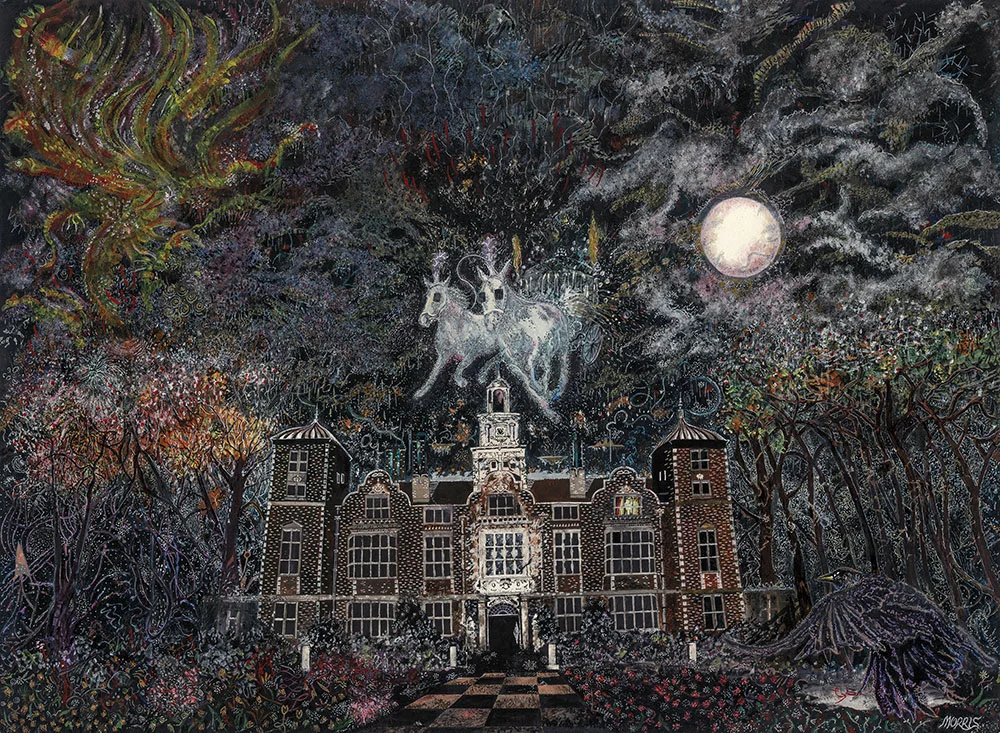
The haunting
The most famous ghost associated with Blickling is Anne Boleyn. According to local tradition, she returns to the Hall every year on 19 May, the anniversary of her execution in 1536. She is said to appear as a ghostly, sometimes headless figure, arriving at the Hall in a spectral coach. The coach itself is traditionally said to be driven by a headless coachman and pulled by four headless horses. Blickling also has a much darker supernatural tradition involving Black Shuck, the enormous black spectral dog of East Anglian folklore. A mid-19th-century document held by the Norfolk Record Office records a tale of a black dog haunting the Hall's drawing room. A later account describes a woman seeing a large black dog cross the room and disappear behind a tapestry, despite the family's own dog being asleep elsewhere.
Reported / claimed activity
◆ ANNE BOLEYN — The ghost of Anne is traditionally said to return to Blickling every 19 May. ◆ THE HEADLESS QUEEN — She is sometimes described as appearing dressed in white and carrying her severed head. ◆ THE SPECTRAL COACH — A ghostly coach is said to arrive at the Hall carrying Anne. ◆ HEADLESS HORSES — Four headless horses are traditionally said to pull the coach. ◆ THE HEADLESS COACHMAN — The coach is said to be driven by a headless figure. ◆ BLACK SHUCK — A huge black spectral dog is associated with the Hall and its surrounding folklore. ◆ THE DRAWING-ROOM DOG — A 19th-century account describes a woman seeing a black dog cross the drawing room, although no second dog could be found. ◆ THE BRICKED-UP TURRET — Local folklore connects the Black Shuck story with an old turret that had supposedly been sealed up for generations. The Story The most famous Blickling legend concerns Anne Boleyn. Blickling is traditionally believed to have been Anne's birthplace, although historians cannot establish her exact birthplace with absolute certainty. She was executed at the Tower of London on 19 May 1536, and local tradition claims that her spirit returns to her childhood home on the anniversary of her death. According to the legend, shortly before midnight on 19 May, a strange coach approaches Blickling Hall. It is pulled by four headless horses and driven by a headless coachman. Inside sits Anne Boleyn, dressed in white and carrying her own severed head. The coach supposedly races towards the Hall before disappearing as it reaches the grounds. The story has become one of Blickling's defining ghost legends and is now included by the National Trust among the famous supernatural stories associated with its properties. But Blickling has another, considerably darker story. After Sir Henry Hobart died following his 1625 duel, folklore developed around his burial and the appearance of a mysterious black dog. The later account recorded by F. J. Meyrick describes a supernatural black dog associated with the Hall and an old turret. The story claims that when the turret was eventually opened many years later, a black dog appeared in the drawing room. One of the women present reportedly saw the animal cross the room and disappear behind a tapestry. The household dog was checked and found to be safely asleep elsewhere. The following morning, the Squire reportedly revealed that the old, bricked-up turret had been opened the previous day. This led to the later interpretation that Black Shuck had somehow been released from the sealed turret. The story is folklore rather than established history, but there is a genuine 19th-century archival record of a black-dog haunting at Blickling
Background and folklore, separate from member eyewitness experiences.
Historical background
Blickling has a long history stretching back to the medieval period. The estate was once owned by Harold Godwinson, the last Anglo-Saxon king of England, and later became the property of the Boleyn family. Thomas Boleyn acquired Blickling in 1505, and it is widely believed that his daughter, Anne Boleyn, was born here around 1501. The Jacobean house standing today was built in the early 17th century by Sir Henry Hobart, replacing the earlier Boleyn residence. Hobart was a wealthy lawyer and landowner who became the 1st Baronet of Blickling. He died in 1625 after being fatally wounded during a duel with Oliver Le Neve. Today, Blickling Hall is one of Norfolk's best-known historic houses and is cared for by the National Trust. The combination of its Tudor associations, Jacobean architecture and centuries of local folklore has given the estate a particularly strong reputation for paranormal activity.
References & research
Sources & background
These sources document the location, story or claimed activity. They do not prove paranormal activity.
- National Trust - Blickling HallLocal history source · National Trust
The History of Blickling Estate
- Norfolk Record Office BlogHistoric record · Norfolk Record Office
The Masque of Anne Boleyn
From the Boo-munity
Boo-munity experiences
The first story could be yours.
No Boo-munity experiences yet. Be the first person to share what happened here.